
Wisdom
Insight into the invisible system

Knowledge is the knowing of information. Understanding is comprehension of the context and why this information is helpful. Learning is the transformation of internalized understanding into behavior. Wisdom is connecting the dots (knowledge and observation) and applying the understanding. Wisdom is having the INSIGHT that can see beyond the surface.
Memorizing information in the assembly-style schooling system does not nourish wise learners. Hence, in V-Work’s culture, we see “LEARNING” as a core value. The goal is not to stay at the knowledge (knowing) stage but to evolve by having wisdom. Knowledge is not power; action from our wisdom to see the truth is power.
Knowledge > Understanding > Learning > Wisdom
A wise person may not be competent, meaning she may lack skill or knowledge in certain areas compared to others. Hence, we should not mistake the different components of competency (knowledge + skill + talent + wisdom). I believe it is easier to understand wisdom as having insights into the ‘system’.
The Iceberg Model in Systems Thinking is a way to present wisdom if we know how to apply our leverage point by seeing beyond the symptom or event.
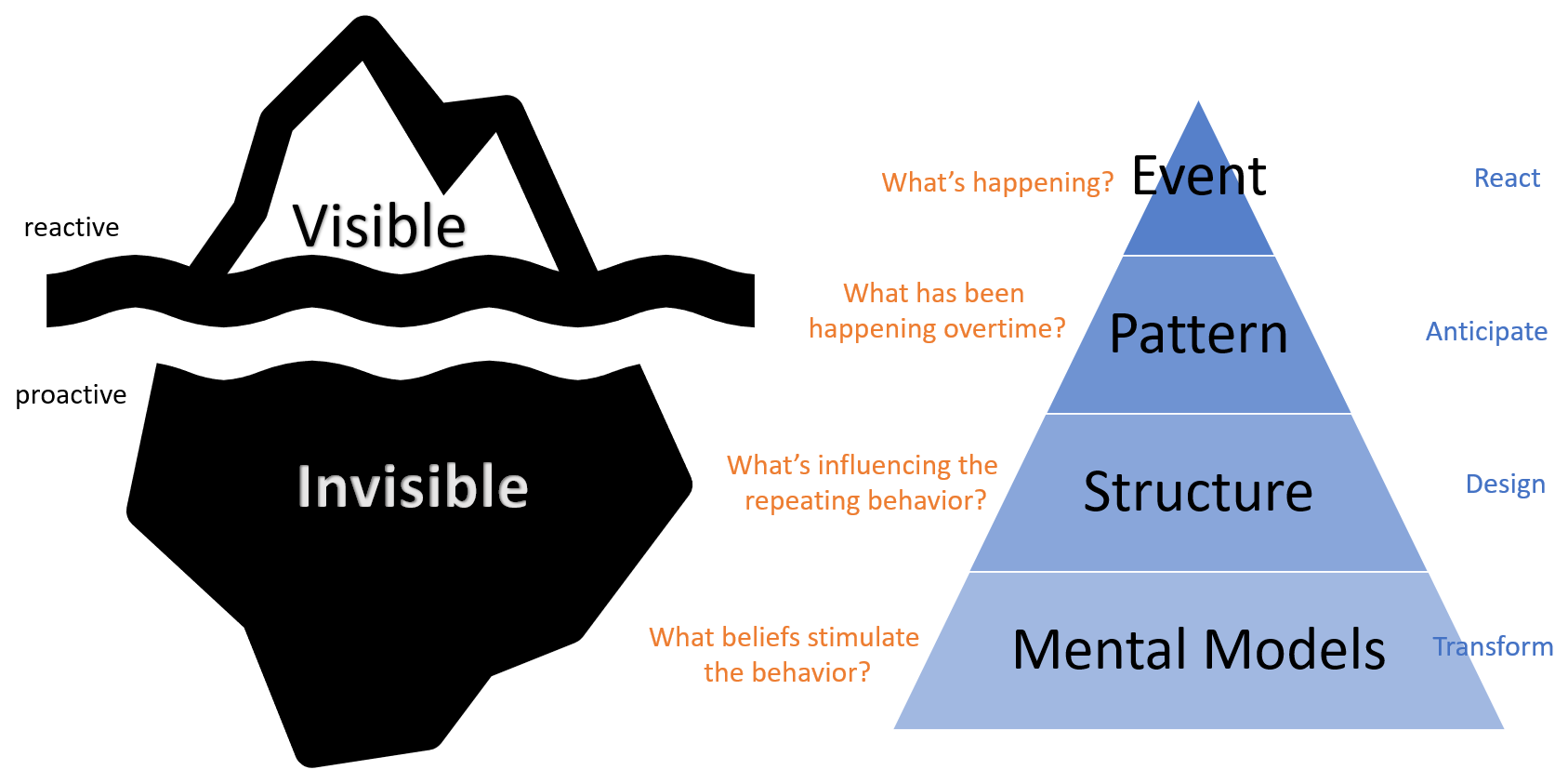
Wisdom empowers us to innovate and think outside the box (limited by our current knowledge and understanding). Learn helplessness is the limiting belief that we have self-imposed onto our mental model that there is nothing else we can do with the current paralyzed dilemma.
Wisdom provides insight into the underlying (invisible) mechanism and principles of the (visible) surface events. Wisdom enables us to have a long-term perspective of indirect distant cause effects. Wisdom provides clarity into chaotic problems, allows us to differentiate the uncontrollable from the controllable elements, and finds the suitable leverage point to solve the problem effectively.
“God, grant me the serenity to accept the things I cannot change, the courage to change the things I can, and the wisdom to know the difference.” - Reinhold Niebuhr, Lutheran theologian (1892–1971)
We associate smartness with intelligence, wisdom, and sound judgment from experience and knowledge. A wise person knows she does not have the answer to every question and does not pretend to be the smartest in the room. A wise person is often humbler because she knows her blind spots and cognitive biases.
“A fool thinks himself to be wise, but a wise man knows himself to be a fool.” - William Shakespeare
[image credit: Bing Image Creator]
Organic Learning Organization (OLO) encourages every team member to seek the truth with curiosity. Lifelong learning is stepping on the shoulders of giants and wise people, studying their works, learning from their mistakes, and validating their advice.
“A smart man makes a mistake, learns from it, and never makes that mistake again. But a wise man finds a smart man and learns from him how to avoid the mistake altogether.” - Roy Williams
Wisdom is not a fixed state or status but a lifelong pursuit of continuous learning. In the context of learning organization, team wisdom can:
provide clarity essential to decision-making
provide insights beyond the observable activities, helpful in problem-solving
improve communication with clear intention and understanding
see every mistake as an opportunity to learn